Tuesday, 17 December 2013

Planning and Research: logo


Here is our logo for our production. We came up with SOLA as it was a mixture of our names. We chose the colours red, black and white as those are the main colours that will be in our film.

Task completed by Somer.

Tuesday, 10 December 2013

Research: Codes and Conventions of thrillers.


We decided to present our codes and conventions of thrillers research as a filmed conversation using shot-reverse-shot.

Task completed by Somer and Aleksandra.

Planning: Classification for out film.

Classification for out film.
We are proposing that out thriller film has a 15 classification.


What does the 15 symbol mean? No-one under 15 is allowed to see a 15 film at the cinema or buy/rent a ‘15’ rated DVD.  15 rated works are not suitable for children under 15 years of age.

How much strong language is there in a 15?

There could potentially be a great deal. At 15 there is no upper limit on the number of uses of strong language (eg f***).
Occasionally there may be uses of the strongest terms (e.g. 'c***'), although continued or aggressive use will not normally be passed 15.

What about discriminatory or offensive terms?

There may be racist, homophobic or other discriminatory language, and the work could explore themes relating to this.
However, at 15 the work as a whole must not endorse discriminatory language or behaviour.

How much sex and nudity is allowed at 15?

At 15 sexual activity can be portrayed, as long as there is no strong or graphic detail. Some sex scenes can be quite long at this category and may involve some nudity and movement. Though nudity may be allowed in a sexual context there should be no strong detail.
There are no constraints on nudity in a non-sexual or educational context.
There can be strong references to sex and sexual behaviour, but especially strong or crude references are unlikely to be acceptable unless justified by context.
Heterosexual and homosexual sex and sex references are treated the same.

Can there be strong violence?

Yes, at 15 violence may be strong. It should not dwell on the infliction of pain or injury, however, and the strongest gory images are unlikely to be acceptable.
Strong sadistic or sexualised violence is also unlikely to be acceptable.
Easily accessible weapons may not be glamorised.

What about sexual violence?

There may be detailed verbal references to sexual violence (for example descriptions of rape or sexual assault in a courtroom scene or in victim testimony) but any portrayal of sexual violence must be discreet and have a strong contextual justification.

What about horror works?

Many horror films are rated 15. At 15 there can be strong threat and menace (as long as it is not sadistic or sexualised), although the strongest gory images are unlikely to be acceptable.

Can you see drugs in a 15 rated film or video?

At 15 drug taking may be shown but the work as a whole must not promote or encourage drug misuse.
The misuse of easily accessible and highly dangerous substances like aerosols or solvents is unlikely to be acceptable at 15.

Task completed by Aleksandra.

Tuesday, 3 December 2013

Planning: Mood Board

This is the mood board we made for our thriller film.
 
Task completed by Somer and Aleksandra.


Preliminary task.

Preliminary task.


Preliminary exercise: Continuity task involving filming and editing a character opening a door, crossing a room and sitting down in a chair opposite another character, with whom she/he then exchanges a couple of lines of dialogue. This task should demonstrate match on action, shot/reverse shot and the 180-degree rule.

Task competed by Somer and Aleksandra.

Tuesday, 26 November 2013

Planning: Old Thiller film location.

Our Thriller location.
 
Here we have our thriller location which is a quiet residential house.  
 
This is the street that the victim will be walking down.
 
Here is a long shot of the same street.
 
This is the exterior of the victim's house.
When the victim gets to the outside door, she'll look around before entering.
This is the victim's kitchen.
This is the table in the kitchen where the victim will be sat. 
 Again here is a wider shot of the scene location.


Task completed by Somer.

Wednesday, 30 October 2013

Research: Narrative Theory.


Narrative Theory.

Vladimir Propp: Propp was a Soviet formalist scholar who analysed the basic plot components of Russian folk tales to identify their simplest complex narrative elements. He divided fairy tales into different sections. These sections allowed him to be able to define the tale into a series of sequences that occurred within the Russian fairy-tale. Usually there is an initial situation, after which the tale usually takes 31 functions. He also established that all the characters could be set into 7 broad character functions in the 100 tales he analysed: (Examples of films where this theory takes place are next to the bullet points). These are--


1. The villain — struggles against the hero. (The Joker in 'The Dark Knight')
2. The dispatcher — character who makes the lack known and sends the hero off. (Nick Fury in 'Avengers Assemble')
3. The helper — helps the hero in their quest. (Robin in 'Batman and Robin')
4. The princess — the character who needs to be rescued. (Gwen Stacey in 'The Amazing Spiderman')
5. The donor — prepares the hero or gives the hero some magical object. (Lucius Fox in 'Batman Begins')
6. The hero — weds the princess. (Spiderman in 'Spiderman')
7. The false hero — takes credit for the hero’s actions or tries to marry the princess. (Darth Vader in 'Star Wars')
Claude Levi-Strauss: Levi-Strauss is a Social Anthropologist;
he recognised that stories automatically reflect the values, beliefs and myths of a culture. These are usually stated in the form of double oppositions. His research has been modified by media theorists to reveal essential themes and symbolic oppositions in media text.
Binary Oppositions: A conflict between two qualities or terms.
The 7 things he underlined were:

Narrative
Values + Ideologies
Institutions
Representation
Language and forms
Audience
Genre

Tzvetan Todorov: Todorov is a Bulgarian Literary Theorist, he proposes that most narratives start with equilibrium, this mean that the protagonist’s life is normal and they are happy. However this state of normality is then disrupted by an outside force, which then means the character(s) have to fight to restore the state of equilibrium. This idea that Todorov has theorized can be applied to a variety of movies.

Equilibrium -> Disequilibrium -> New Equilibrium
 
 
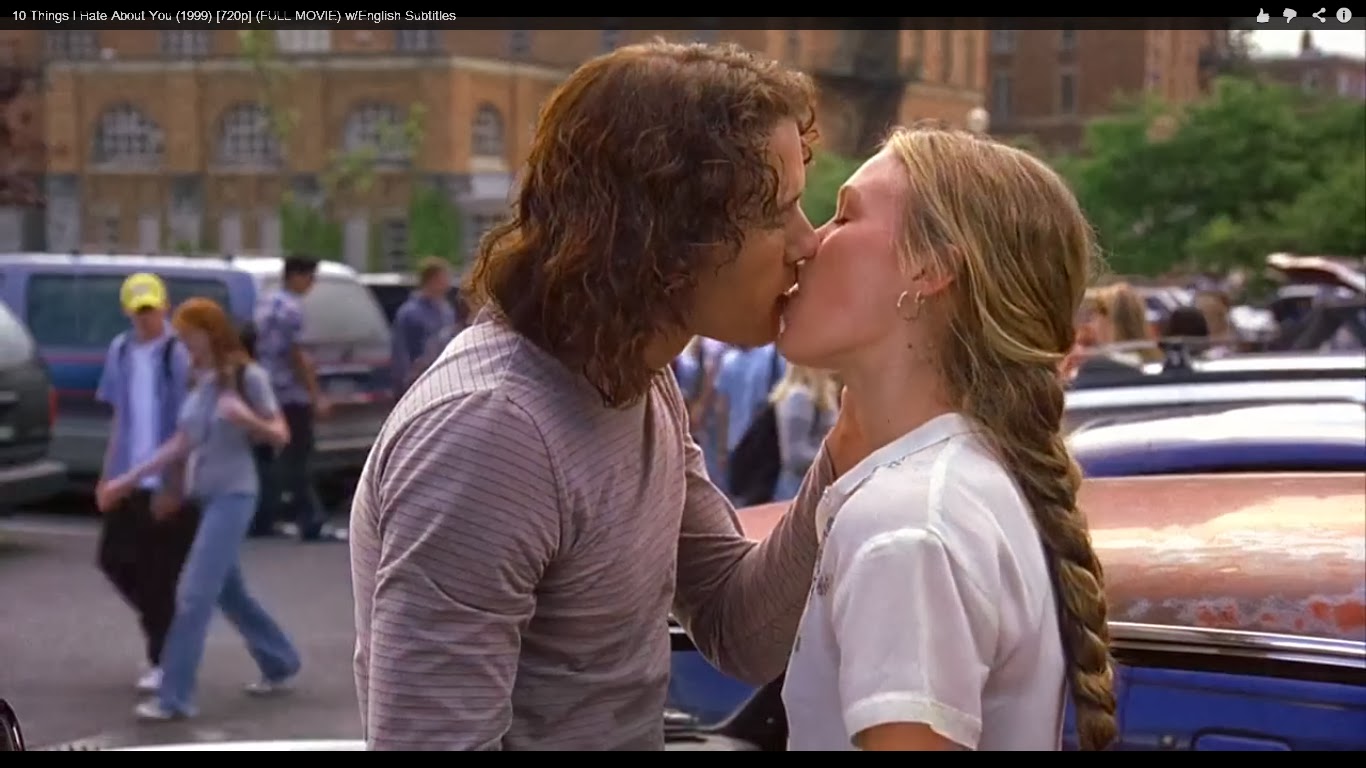
Beginning: The beginning of the film shows what life is like before something swoops in and wreaks it all. In 10.T.I.H.A.Y Kat is someone who comes off as a bit of a cow, who doesn't care what people say about her. She's also someone who hates love.
 
 
Complication: The complication is effectively the storm, however it only lays a path for what is to come. In the screenshot we see the sisters dad telling the girls that unless Kat starts dating then her sister Bianca can't.
 
 
Climax: The climax is where the majority of the drama takes place, here in the screenshot we see Patrick Verona trying to ask Kat on a date as he was asked to help get her to start dating.

 
Resolution: A resolution doesn't always turn out to be positive, but in the film Kat finally learns how to love as you can see in the screenshot.
 
 
Task completed by Somer.